(I started this entry over a year ago, but refrained from publishing it. It's nothing substantial, devoid of relevance, a muddy pile of pseudo-observational, non-reflective associations. A mind's meandering, without τέλος.)
 There is something undefinably strange about Murakami's stories which as I've found during the years of reading his works, particularly his short prose, responds to me in a way no other author's writing does. It has an intuitive, irrational appeal, one that I cannot put my finger on. It's positively simplistic and yet, whenever I read a story from my favourite book of his, The Elephant Vanishes, a force of inexplicable nature starts minding its business on the terrains of my brain, ending in uplift. Its origin unknown, it's a sentiment not unlike the unease that befalls me at the sight of industrial parks, only that the latter is of course entirely unpleasant. Similarly, when I was younger, I used to have short episodic experiences during which I sensed an entity of sorts behind my back, out to haunt me, generating a feeling not unlike the one sensible in the Winkie's Dream scene in Mulholland Drive. In my mind, I must have personified that fear in the form of a wolf and during that time, I also happened to develop a dread towards listening to my LP of Prokofiev's Peter and the Wolf. End of misplaced detour.
 There is something undefinably strange about Murakami's stories which as I've found during the years of reading his works, particularly his short prose, responds to me in a way no other author's writing does. It has an intuitive, irrational appeal, one that I cannot put my finger on. It's positively simplistic and yet, whenever I read a story from my favourite book of his, The Elephant Vanishes, a force of inexplicable nature starts minding its business on the terrains of my brain, ending in uplift. Its origin unknown, it's a sentiment not unlike the unease that befalls me at the sight of industrial parks, only that the latter is of course entirely unpleasant. Similarly, when I was younger, I used to have short episodic experiences during which I sensed an entity of sorts behind my back, out to haunt me, generating a feeling not unlike the one sensible in the Winkie's Dream scene in Mulholland Drive. In my mind, I must have personified that fear in the form of a wolf and during that time, I also happened to develop a dread towards listening to my LP of Prokofiev's Peter and the Wolf. End of misplaced detour.
May it just be my deficient mind triggered by the coincidental presence of a handful of similar symbols and motives, but upon seeing Koji Morimoto's Beyond (part of the Animatrix collection of Matrix-related side stories) some years ago, I somehow felt it illustrated parts of Murakami's short-story The Wind-up Bird and Tuesday's Women (which is also the beginning of his novel Wind-up Bird Chronicle. Although the protagonist is nameless in the short-story, we shall go by the name used in the novel: Toru Okada.) Essentially, both protagonists, in search of their missing cat that went astray, stumble within a perfectly real surrounding into something surreal. As someone put it, "in the world of Haruki Murakami, bizarre events take place with striking regularity and, also with [striking] regularity, they are accepted as simply the stuff of everyday life."
 The sense of something being not quite right takes on a more literal and empirically tangible form in Beyond. The old and notoriously haunted house and the yard surrounding it represent a glitch in the matrix, a blemish according to the official point of view, and all the consequences it entails. Rain coming from the ceiling despite a clear blue sky outside, glass bottles reassembling after being shattered, broken lightbulbs which flicker briefly, cans and kids floating in mid-air. The excitement the location inspires for the few children who know about it is but shortlived as a team of agents becomes aware of the glitch and immediately takes action to fix it.

Just to quench any anticipation you may have accumulated up to this point, as to the purpose and merit of this entry: there is not going to be any. Let's proceed then with my incoherent mental meandering. The protagonist's wife suggests that the cat is "in the yard of that vacant house at the end of the passage." According to Beyond, that's indeed where she is. During his search, the protagonist encounters a precocious teenage girl who smokes Hope cigarettes and says that maybe, three or four days ago, she's seen a cat of striped variety that could have been the protagonist's, tip of the tail slightly bent and all, stating that "our yard is a kind of highway for the neighborhood cats." She invites him into her garden, suggesting they wait together for the cat to appear. Similarly in Beyond, Yoko happens upon a young reckless boy who leads her to the strange run-down building he's found together with his friends, stating that he's seen her cat there.
 Murakami often uses secondary characters more or less close to the protagonist or becoming acquainted with him through the course of the story, who certainly cause part of the puzzlement of both the narrator and the reader. In a good deal of cases, it's the wife of the protagonist who assumes said role and coincidentally, we don't have to look any further than Murakami's collection The Elephant Vanishes to find two examples of this. In The Wind-up Bird and Tuesday's Women, the protagonist's wife believes that the cat is in the yard of a vacant, run-down house at the end of dubious narrow alley, where she has already seen her several times before. The protagonist wonders what motives could have driven his wife to such a shady place, citing his wife's latent arachnophobia along the way, and by the end of the story, we still don't know anymore about this. Another example of such inscrutability is evident in The Second Bakery Attack, when an overwhelming and strangely unnatural hunger befalls the protagonist and his wife in the middle of the night. This triggers a memory of his teenage years when he and a friend robbed a bakery because they didn't have the money to buy bread. After relating the incident to his wife, she thinks that during that time he became infected with a curse and as the two of them lack anything substantial to eat, they decide to rob a McDonald's, to get rid of the curse and their hunger. The swiftness or "practiced efficiency," as the protagonist calls it, with which his wife tapes the numbers on the license plate of their car, the fact that she owns a Remington shotgun and ski masks when the two of them had never skied before, the confidence she displays during the burglary.
telephone, cat food, look out of window / veranda, wind-up bird / dove in slow-motion, vacant house, wall, asking neighbours
dog? rainbow?
"My guess is that the cat's probably in the yard of that vacant house at the end of the passage. The yard with the stone bird figurine. I've seen him there often enough. You know where I'm talking about?"
I go to the kitchen for that drink of water, turn on the FM radio, and trim my nails. They're doing a feature on Robert Plant's new album. I listen to two songs before my ears start to hurt and I switch the thing off. I go out to the porch to check the cat's food dish (0:30); the dried fish I put in the previous night hasn't been touched. Guess the cat really hasn't come back.
Standing there on the porch (1:25), I look at the bright spring sun slicing down into our tiny yard. Hardly the sort of yard that lingers fondly in the mind. The sun hits here only the briefest part of the day, so the soil is always dark and damp. Not much growing: just a couple of unremarkable hydrangeas. And I'm not terribly crazy about hydrangeas in the first place.
From a nearby stand of trees comes the periodic scree-ee-eech of a bird, sharp as a tightening spring. The "wind-up bird," we call it.
 The sense of something being not quite right takes on a more literal and empirically tangible form in Beyond. The old and notoriously haunted house and the yard surrounding it represent a glitch in the matrix, a blemish according to the official point of view, and all the consequences it entails. Rain coming from the ceiling despite a clear blue sky outside, glass bottles reassembling after being shattered, broken lightbulbs which flicker briefly, cans and kids floating in mid-air. The excitement the location inspires for the few children who know about it is but shortlived as a team of agents becomes aware of the glitch and immediately takes action to fix it.
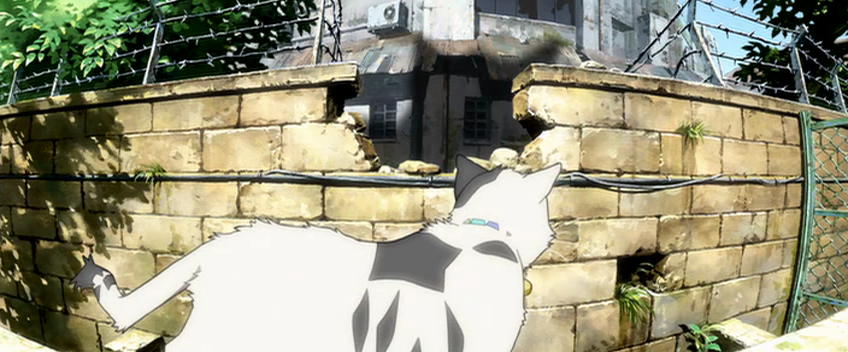
telephone, cat food, look out of window / veranda, wind-up bird / dove in slow-motion, vacant house, wall, asking neighbours
dog? rainbow?
"My guess is that the cat's probably in the yard of that vacant house at the end of the passage. The yard with the stone bird figurine. I've seen him there often enough. You know where I'm talking about?"
I go to the kitchen for that drink of water, turn on the FM radio, and trim my nails. They're doing a feature on Robert Plant's new album. I listen to two songs before my ears start to hurt and I switch the thing off. I go out to the porch to check the cat's food dish (0:30); the dried fish I put in the previous night hasn't been touched. Guess the cat really hasn't come back.
Standing there on the porch (1:25), I look at the bright spring sun slicing down into our tiny yard. Hardly the sort of yard that lingers fondly in the mind. The sun hits here only the briefest part of the day, so the soil is always dark and damp. Not much growing: just a couple of unremarkable hydrangeas. And I'm not terribly crazy about hydrangeas in the first place.
From a nearby stand of trees comes the periodic scree-ee-eech of a bird, sharp as a tightening spring. The "wind-up bird," we call it.